Mexico did not announce a new residency income requirement this year. The requirement changed anyway, on 1 February, because it is not a number. It is a formula, and the index inside it moved.
That sounds like a joke. It is arithmetic.
The thing everyone does, and why it fails
You are considering Mexico. You find your nearest Mexican consulate, open the temporary residency page, and there it is: a peso figure, and helpfully, a dollar figure next to it. You write the dollar figure down. You check your bank statements against it.
That dollar figure is the least reliable number on the page, and it is the one almost everyone copies.
It is wrong in two independent ways, and they stack.
Drift one: the requirement is not a number
Mexico does not set its residency income bar in pesos. It sets it as a multiple of a daily reference unit, and then the reference unit moves on its own schedule.
For temporary residency by economic solvency, the federal formula is 680 times the daily UMA.
UMA is the Unidad de Medida y Actualización, an index INEGI recalculates every year. For 2026 it was published in the Diario Oficial on 9 January and took effect on 1 February at 117.31 pesos a day, up from 113.14.
So the monthly income requirement for 2026 is:
680 × 117.31 = 79,770.80 pesos a month
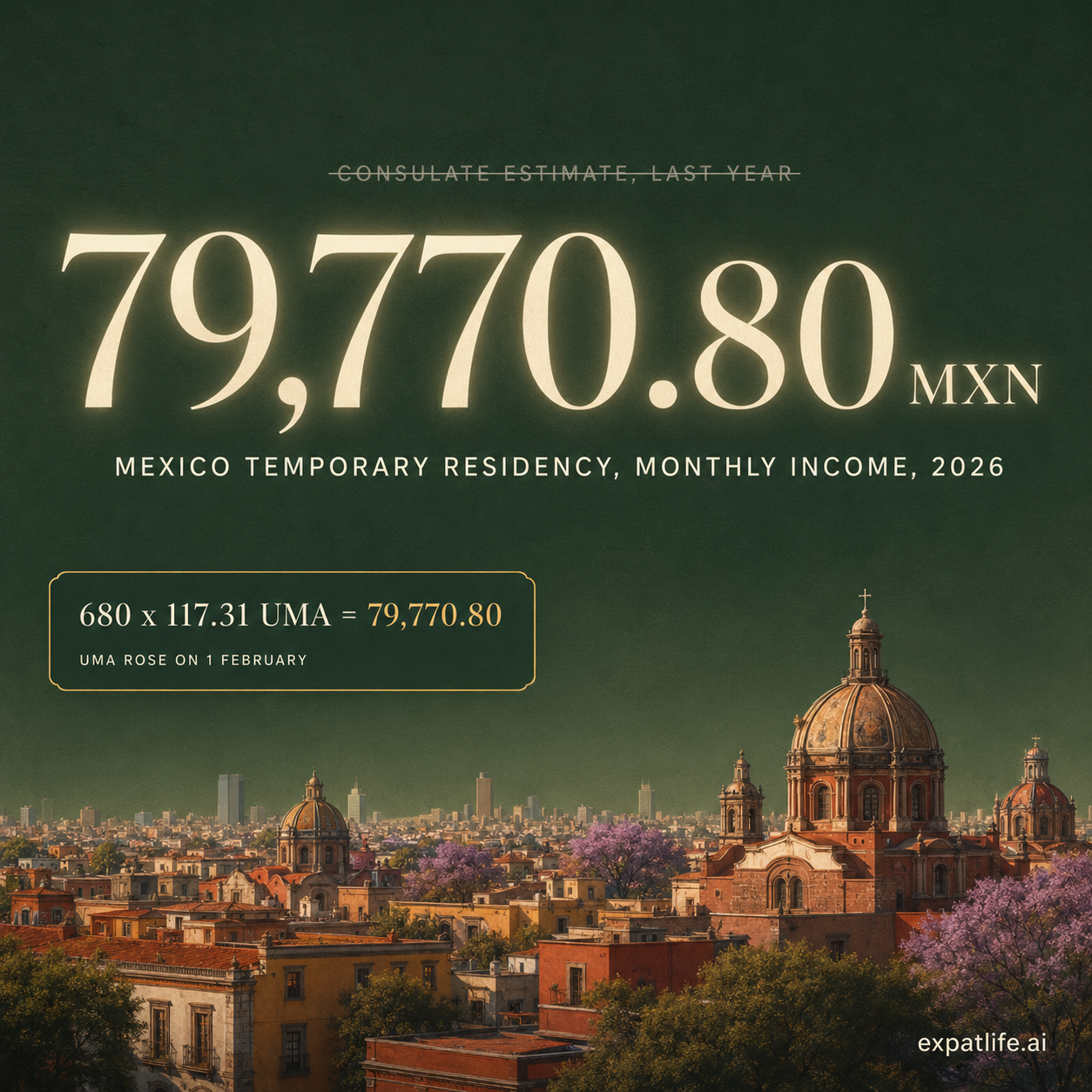
Nobody announced a new residency requirement. The index moved 3.69%, and every peso figure keyed to it moved with it on 1 February.
The same multiplication runs through the rest of the requirements:
| Requirement | Multiple | 2026 figure |
|---|---|---|
| Temporary residency, monthly income | 680 × UMA | 79,770.80 pesos |
| Temporary residency, savings or investments | 11,460 × UMA | 1,344,372.60 pesos |
| Each additional dependent | 220 × UMA | 25,808.20 pesos |
If you are reading a figure that does not divide cleanly by 117.31, you are reading last year's number.
Drift two: the dollar figure is frozen
The peso figures above are at least derivable. The dollar and euro estimates consulates publish next to them are not.
They are stale twice over. They are computed from whatever the reference unit was when someone typed the page, and converted at whatever the exchange rate was that same day. Neither gets recalculated when the index resets in January or February, and the exchange rate moves every day the page sits there.
One Mexican embassy page in Europe still carries a November 2025 update date and quotes an income figure of roughly €3,550. The peso requirement has moved since. The euro rate has moved since. The page has not.
A consulate's dollar estimate is a screenshot of a moving number, and the screenshot is not dated in a way that tells you it is stale.
What to do instead
- Work in pesos, always. Take the multiple, times today's UMA. Then convert it yourself, today, at a rate you can see.
- Do not budget to the line. Between the index reset and the exchange rate, the honest planning number sits comfortably above the published one, not on it.
- Re-check in February, not January. INEGI publishes the new UMA in January but it takes effect on 1 February. A figure that was correct in the third week of January can be out of date by the first week of February.
Why this pattern matters beyond Mexico
Mexico is unusually explicit about it, but the mechanism is everywhere. Portugal's D7 and D8 key off its minimum wage. Spain's non lucrative visa keys off the IPREM. Several countries in Latin America key off exactly this kind of index.
In every one of those cases, the number circulating on relocation sites is a snapshot of a formula, and the formula keeps running after the snapshot is taken.
We publish the Mexico country guide and the Portugal country guide with the instrument named beside each figure and the date we last read it, for exactly this reason. If you want your own situation checked against the instruments rather than against a listicle, that is what the Personal Relocation Assessment is.
Key takeaways
- Mexico's 2026 temporary residency income requirement is 79,770.80 pesos a month, which is 680 times the daily UMA of 117.31.
- The UMA rose 3.69% on 1 February 2026, from 113.14 to 117.31, and every peso figure keyed to it rose with it.
- The dollar and euro estimates on consulate pages are computed from a past index at a past exchange rate and are not recalculated.
- Do the multiplication in pesos, then convert it yourself, on the day.
Sources. UMA 2026 values: INEGI press release 1/26, published in the Diario Oficial de la Federacion on 9 January 2026, in force 1 February 2026. Solvency multiples: Lineamientos Generales para la expedicion de visas, Diario Oficial de la Federacion, 10 October 2014, as applied by Mexican consulates.
Research and drafting assistance: Claude (Anthropic). Verification against the published instruments, editing and final responsibility: ExpatLife Editorial Team, 27 August 2026.
Personal Relocation Assessment
This article is general. Your situation is not.
Tell us your nationality, income and timeline and we research it by hand: where you actually qualify, the route, the current threshold with the law it comes from, and what usually goes wrong in a position like yours. Written by an expert, in 3 working days.
Enjoyed this article?
Subscribe for more expat tips and guides.
Which country is right for you?
Answer 6 quick questions about your budget, lifestyle, and priorities. Our AI ranks 122 countries and builds a personalised relocation plan.
Enjoyed this article? Share it with fellow expats