
If you hold an H-4 EAD, you have probably had a difficult week. The headlines say the United States is stripping H-1B spouses of the right to work. Your WhatsApp groups are worse.
Here is what actually happened, in full.
On 14 August 2026, the Department of Homeland Security published its Unified Agenda. Inside it is an entry, RIN 1615-AD14, titled "Removing H-4 Dependent Spouses From the Classes of Noncitizens Eligible for Employment Authorization". It states an intention to reverse the 2015 rule that made certain H-4 spouses eligible to apply for work authorisation.
That is the entire event.
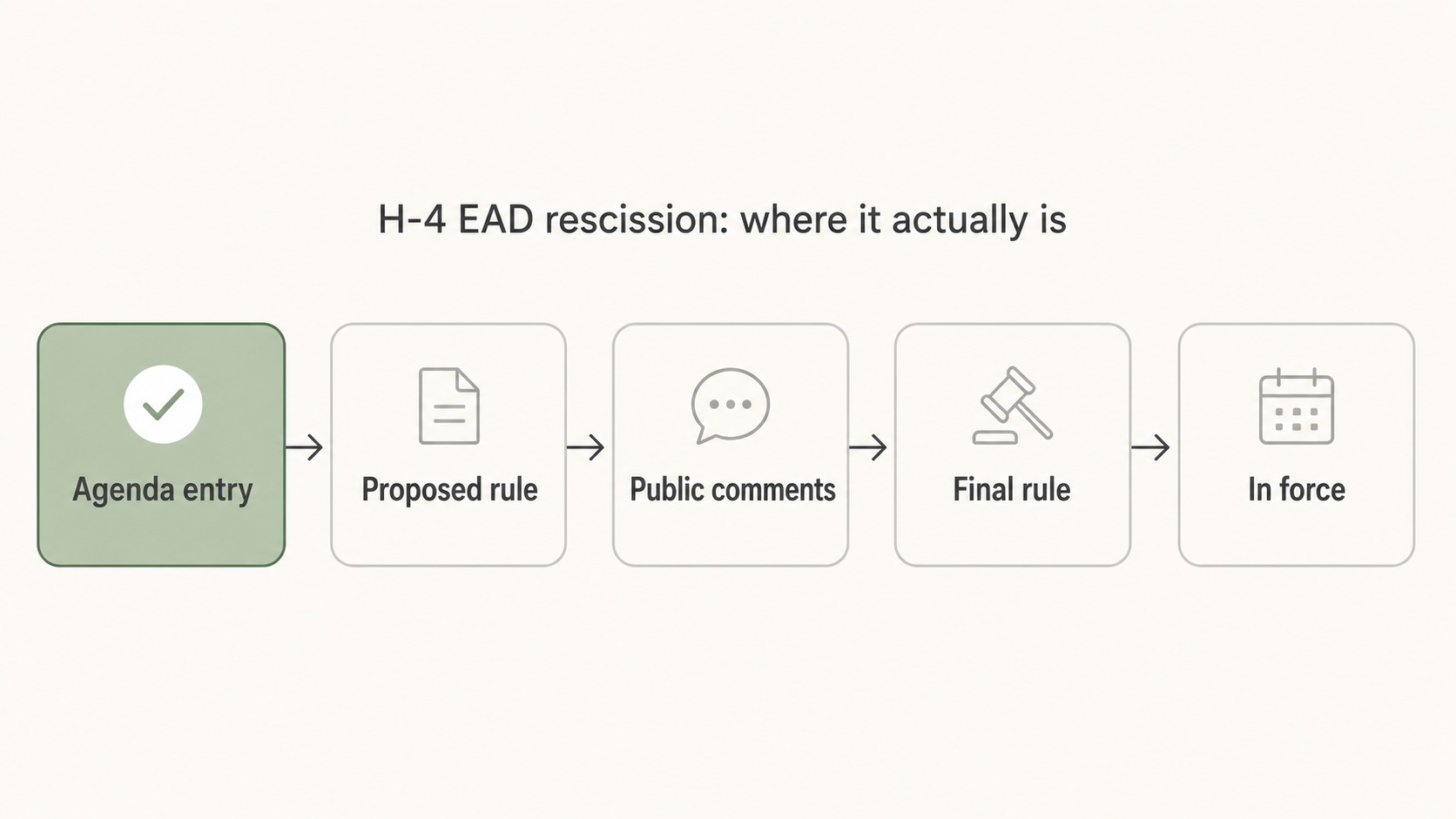
What a Unified Agenda entry is, and is not
The Unified Agenda is a list of regulations an agency is thinking about. It is published twice a year. Appearing on it commits DHS to nothing, binds nobody, and changes no existing document.
The entry's own publication date for a proposed rule reads To Be Determined.
So, concretely, as of today:
- No rule has been proposed.
- No comment period has opened or closed.
- No final rule exists.
- No H-4 EAD has been revoked, shortened or invalidated.
- Nobody has lost the right to work.
If you have a valid EAD in your hand, it is still valid, on its own terms, until the date printed on it.

What would have to happen first
For an existing H-4 EAD to stop being valid, DHS would have to work through the Administrative Procedure Act, and each of these steps is a real one:
- Publish a Notice of Proposed Rulemaking. Not yet done. No date set.
- Open a public comment period. Usually 30 or 60 days.
- Read and respond to the comments. The 2015 rule drew tens of thousands. An agency that ignores them creates grounds for the final rule to be struck down, so this is not a formality.
- Publish a final rule with an effective date.
- Survive the litigation that would follow within days.
None of that has started. The first step has not happened.
The part almost nobody is mentioning
This has been tried before.
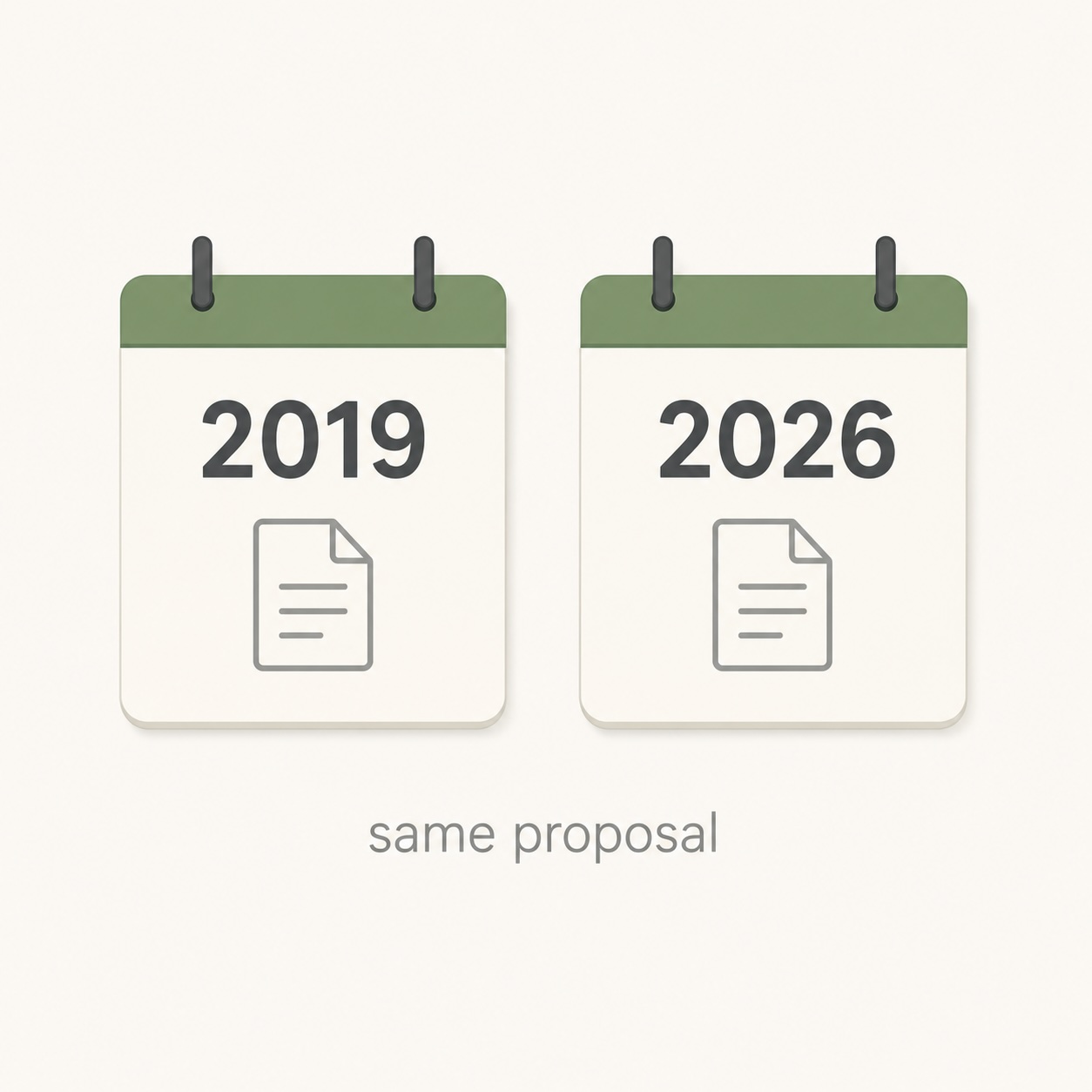
The first Trump administration proposed rescinding H-4 work authorisation in 2019. It went through the same agenda process, generated the same headlines, and was never finalised. The rule is still standing today, eleven years after it was made.
It has also been through the courts, in the other direction. In Save Jobs USA v. DHS, a group of technology workers argued DHS never had the authority to issue the H-4 EAD rule at all. The district court granted summary judgment for DHS in March 2023, and the D.C. Circuit affirmed on 2 August 2024. The rule survived.
None of that makes rescission impossible. A future administration can lawfully undo a rule it has the authority to make, and this one may move faster than the last. But it does mean the correct reading of last month's news is "this has been announced again", not "this has happened".
What is actually worth doing this month
Not panicking is not the same as doing nothing. Four things are genuinely sensible, and none of them depends on predicting the outcome.

Renew the moment your window opens. This changed last year and it is the part that bites now. For renewal applications filed on or after 30 October 2025, USCIS ended the automatic extension that used to bridge the gap while a renewal was pending. If your card expires before the new one is approved, your authorisation stops on the expiry date and does not resume until a new card is issued. Filing late is no longer a paperwork problem, it is unpaid leave.
Know which category you are in. H-4 work authorisation depends on the H-1B spouse either holding an approved I-140, or having an H-1B extension beyond the six-year limit under AC21. Those are different situations with different timelines. If you do not know which one applies to your household, find out this week rather than reading it off a forum.
Keep your own file. Approval notices, EAD cards, I-140 receipt and approval, H-1B approvals, passport stamps. Not because anything is about to happen, but because reconstructing this under time pressure is miserable and people always underestimate how scattered it is.
Look at what else you hold. Some people on H-4 have an independent path they have never priced: their own employer willing to sponsor, a spouse's approved I-140 with a priority date closer than they think, or a second citizenship that opens a different country entirely. That is worth knowing before it is urgent, not after. If the green card queue is the thing actually constraining you, we wrote about what the EB-2 India backlog really means in detail.
The honest summary
Nothing has changed yet. Something might.
The people telling you your permit is gone are wrong today. The people telling you it will never happen are guessing. What is true is that a long, public, challengeable process would have to run first, none of it has begun, and you will see the proposed rule published before anything binds you.
Watch for the Notice of Proposed Rulemaking. That is the moment this becomes real, and it is the moment public comments matter.
Our United States visa guide tracks the current routes and thresholds, and our India country guide covers the other side of this decision for households weighing a move back. If you want your own situation looked at against the rules rather than against a headline, that is what a Personal Relocation Assessment is for.
Sources
- DHS Unified Agenda entry, RIN 1615-AD14, published 14 August 2026
- National Law Review, DHS moves to rescind the H-4 EAD rule
- Immigration Policy Tracking Project, H-4 EAD rescission entry
- Save Jobs USA v. DHS, No. 23-5089, D.C. Circuit, 2 August 2024
- USCIS interim final rule ending the 540-day automatic EAD extension for renewal applications filed on or after 30 October 2025
This is general information about a regulatory process, not legal advice about your case. Anything that turns on your own dates should go to an immigration attorney.
Research and drafting assistance: Claude (Anthropic). Verification against the reginfo.gov agenda entry, the D.C. Circuit opinion and the 2015 rule, editing and final responsibility: ExpatLife Editorial Team, 1 September 2026.
Personal Relocation Assessment
This article is general. Your situation is not.
Tell us your nationality, income and timeline and we research it by hand: where you actually qualify, the route, the current threshold with the law it comes from, and what usually goes wrong in a position like yours. Written by an expert, in 3 working days.
Enjoyed this article?
Subscribe for more expat tips and guides.
Which country is right for you?
Answer 6 quick questions about your budget, lifestyle, and priorities. Our AI ranks 122 countries and builds a personalised relocation plan.
Enjoyed this article? Share it with fellow expats


