
This article is brought to you in partnership with TravelDoctor-es, a telemedicine platform for expats and travellers in Spain and Latin America.
You've finally made the move. The visa came through, the apartment is sorted, and you're settling into life abroad. Then it hits you: a sinus infection. Or you run out of your blood pressure medication. Or your kid wakes up with a fever at 11 PM.
You don't speak the local language fluently. You don't have a family doctor yet. And the public hospital wait times you've heard about? Suddenly very real.
This is the moment most expats discover that healthcare logistics — not healthcare quality — is the real challenge of moving abroad.
Key Takeaways
- Healthcare quality abroad is rarely the problem — accessing it efficiently is.
- Telemedicine is a legitimate option for non-emergency care, especially for prescription refills, minor infections, mental health follow-ups, and travel-related issues.
- The "WhatsApp-to-pharmacy" workflow eliminates the biggest friction point: getting a legal local prescription without leaving your apartment.
- Always have a local backup plan — telemedicine works for most issues but not for emergencies. Know your nearest hospital, ambulance number, and have basic insurance.
- Bring 3 months of any specialty medication when you move, then transition to local prescriptions before that runs out.
The Three Healthcare Headaches Every Expat Faces
 Long pharmacy queues and language barriers are a daily reality for many expats — especially in unfamiliar cities.
For most expats, the issue isn't the quality of doctors abroad — it's access. Spain has one of the best public healthcare systems in Europe. Mexico's private hospitals rival U.S. facilities. Argentina has more psychologists per capita than any city on Earth. The problem is figuring out how to actually use these systems when you're new, jet-lagged, and don't speak the language.
Here are the three pain points that come up again and again in our country healthcare guides:
1. The Hospital Queue Trap
In Spain's public Seguridad Social system, getting a non-urgent appointment with a GP can take 1–3 weeks. In Mexico's IMSS, it can be longer. Even private hospitals in Buenos Aires or Santiago are stretched. If you have an ear infection on a Sunday night, you're either heading to urgencias (emergency room) or waiting it out.
For something minor, both options are bad: ER visits are expensive and slow, while waiting risks the condition getting worse.
2. The Language Barrier
This isn't just an inconvenience — it's a safety issue. Misunderstanding dosage instructions, missing an allergy, or struggling to describe symptoms accurately can have real consequences.
Spain has English-speaking doctors in major cities, but they're concentrated in expensive private clinics in Madrid and Barcelona. In smaller cities and across most of Latin America, finding one is harder than you'd think.
3. The Prescription Problem
Here's the one nobody warns you about: prescriptions written in your home country aren't valid abroad. If you brought a 3-month supply of medication and it runs out, you can't just call your doctor back home. You need a local prescription, written by a locally licensed doctor, valid at a local pharmacy.
For controlled substances (anxiety meds, sleep aids, ADHD medication), this isn't optional. Pharmacies will not dispense them without proper documentation.
How Telemedicine Solves All Three
Over the last few years, telemedicine has quietly become the best-kept secret of long-term expats. A good telemedicine service handles all three pain points at once:
- No queue: Book a consultation in minutes, see a doctor within the hour
- English-speaking by default: No more translating symptoms with Google
- Real legal prescriptions: Issued by locally licensed doctors, valid at local pharmacies
But not all telemedicine services are created equal. Many require app downloads, complex registration flows, or only operate in specific cities. And many issue prescriptions that aren't actually accepted at most pharmacies.
The TravelDoctor-es Approach
 TravelDoctor-es — telemedicine for expats and travellers in Spain and Latin America.
TravelDoctor-es is one of the few telemedicine platforms specifically built for expats and travellers in Spain and Latin America. Their workflow is designed to remove every friction point:
The Consultation
They use Doxy, a specialised medical platform that runs entirely in your browser. The patient just clicks a link and enters a virtual waiting room. No app downloads. No registrations. No tech hassle.
No registration or app download required. This matters more than it sounds. Anyone who has tried to install a clunky telemedicine app while feeling sick at 9 PM in a foreign country knows the value of "just click a link."
The Prescription
Once the consultation ends, the doctor issues an official digital prescription and sends it directly via WhatsApp (or email if preferred). It's a PDF with the doctor's licence number, signature, and all the legal markers required by local pharmacies.
This is the part most other telemedicine services get wrong. A "recommendation" or "doctor's note" isn't the same as a legal prescription. TravelDoctor-es issues real prescriptions that are recognised by pharmacies in both Spain and across Latin America.
The Pharmacy
You walk into any local farmacia, show the PDF on your phone, and they fill it. That's it. No printing required. No translation needed. No back-and-forth with your insurance.
For Spain specifically, this means using their service for digital prescriptions in Spain — their doctors are licensed in Spain and the prescriptions are valid at any Spanish farmacia.
For Mexico and Latin America, the same workflow applies through their English speaking doctor in Mexico service.
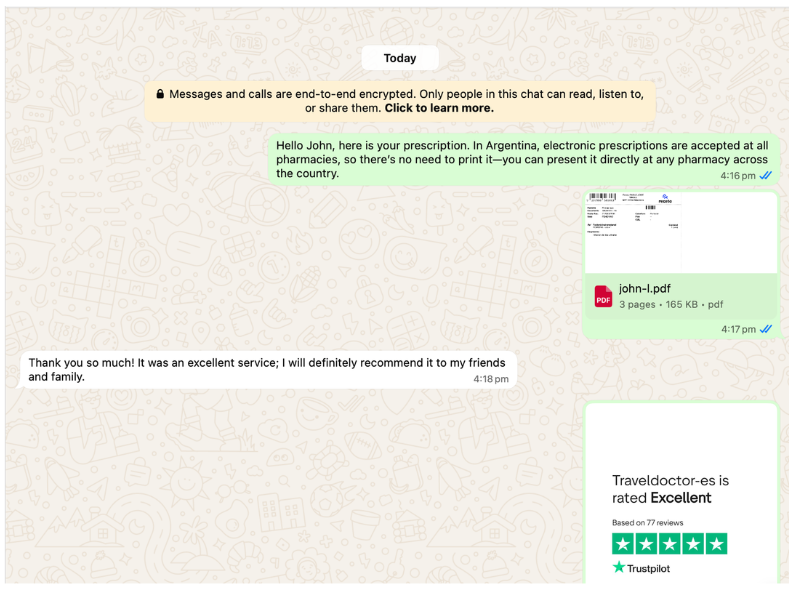 A real example: an official digital prescription delivered directly via WhatsApp, ready to use at any local pharmacy. (Patient details have been removed for privacy.)
When Telemedicine Works (And When It Doesn't)
Telemedicine is excellent for:
| Use Case | Why It Works |
|---|---|
| Prescription refills | Doctor reviews your case, issues a local prescription |
| Minor infections (UTIs, sinus, throat) | Doctor can prescribe antibiotics if appropriate |
| Mental health follow-ups | Established therapist relationship, no commute |
| Travel medicine (vaccines, malaria prophylaxis) | Pre-trip consultations from anywhere |
| Second opinions | English-speaking specialists for complex cases |
It's not a replacement for:
- Emergencies (call local emergency services)
- Hands-on physical exams (suspected fractures, abdominal pain)
- Surgical consultations
- Anything involving imaging or lab work that requires a clinic visit
What to Do This Week
If you've recently moved abroad — or you're planning to — here's a practical checklist:
- Bookmark a telemedicine service before you need it. The worst time to research healthcare options is when you're already sick.
- Save your nearest 24-hour pharmacy in Google Maps. In Spain it's called farmacia de guardia; in Mexico/LATAM it's farmacia 24 horas.
- Take photos of your medication labels so you have the active ingredient name (the generic name often differs between countries).
- Get basic expat health insurance — even a low-cost plan covers emergencies.
- Research the local healthcare system for your country with our country-specific guides:
The Bottom Line
Moving abroad is exciting, but the small healthcare emergencies — the ones that happen at 10 PM on a Tuesday — are what catch most expats off guard. The good news: telemedicine has matured to the point where most of these can be handled in 20 minutes from your couch.
Services like TravelDoctor-es make the process genuinely frictionless: click a link, talk to a doctor in English, get a legal prescription on WhatsApp, walk to the pharmacy. It's the kind of thing that, once you've used it, you can't believe wasn't always available.
Combine it with a solid understanding of your local healthcare system — and a bit of pre-arrival prep — and you'll handle 95% of medical issues without ever setting foot in a waiting room.
Disclosure: This article is sponsored by TravelDoctor-es. ExpatLife.AI maintains full editorial control over content. We only partner with services we believe genuinely help our readers.
Last updated: April 10, 2026
Personal Relocation Assessment
This article is general. Your situation is not.
Tell us your nationality, income and timeline and we research it by hand: where you actually qualify, the route, the current threshold with the law it comes from, and what usually goes wrong in a position like yours. Written by an expert, in 3 working days.
Enjoyed this article?
Subscribe for more expat tips and guides.
Which country is right for you?
Answer 6 quick questions about your budget, lifestyle, and priorities. Our AI ranks 122 countries and builds a personalised relocation plan.
Enjoyed this article? Share it with fellow expats