Western Europe
Central & Eastern Europe
Asia & Middle East
Americas
Oceania & Africa
Expat Topics
🇸🇰 The expat guide · 2026
Slovakia.
Central Europe's hidden gem - EU access, stunning nature, and living costs half of Vienna just 60 km away.
Minimum Wage
€915/mo gross
From 1 Jan 2026 (+12.1% from €816); national statutory rate
Currency
Euro (€)
Eurozone member since 2009
Income Tax (2026)
19% / 25% / 30% / 35%
NEW 4-tier: brackets at €44K / €60K / €75K
VAT (standard)
23%
Now applies to confectionery, ice cream, snacks (2026)
1-BR Rent (Bratislava)
€700–€900
City centre (2026); 50–60% below Vienna
Global Peace Index
#34
GPI 2026 ranking
Verified August 13, 2026
See 5 more figuresCan you actually move to Slovakia?
We research your nationality, income and timeline against Slovakia's current rules, and tell you whether you qualify and what it actually costs.

Why move to Slovakia?
Slovakia is one of Central Europe's most underrated expat destinations, offering EU membership and Schengen access at remarkably affordable prices. Bratislava sits just 60 km from Vienna - the closest capital-to-capital distance in Europe - yet rents are 50–60% lower. **2026 Consolidation Package (in force 1 Jan)**: PIT now FOUR-tier: 19% to €44,000 / 25% to €60,000 / **30% to €75,000 (new) / 35% above €75,000 (new)**. Health insurance contribution +1 percentage point for all workers. **VAT 23% standard now applies to confectionery, ice cream, jams, savory snacks** (previously reduced rate). Self-employed: contribution holidays ABOLISHED, minimum contributions raised. New corporate min tax €11,520 for companies with revenue >€5M (up from €3,840). Employer pays first 14 days of sickness (up from 10). **Digital immigration platform fully live since 18 Feb 2026** - apply for residence/Blue Card online, just fingerprints in person. The High Tatras offer world-class skiing within 3-4hr of Bratislava; Košice anchors a growing eastern tech hub.
The rest of the Slovakia numbers
The figures that did not fit in the summary above.
| Figure | Detail |
|---|---|
| Health Insurance+1 pp from 2026 | Workers + self-employed; min base 60% of avg wage |
| Digital ImmigrationLive since 18 Feb 2026 | Apply online; fingerprints in person within 30 days |
| EU Blue Card 2026€3,096/mo standard | Sought-after occupations €2,972/mo (in force since 6 Mar 2025); 6-mo min employment contract |
| Min Corp Tax€11,520 (rev >€5M) | Raised from €3,840; new license bracket added for largest companies |
| Immigration Reform Live 15 Jul 2026New Central Visa Authority | Slovakia implemented multiple reforms: extended national visa validity, more relaxed unemployment periods for residence-permit holders, new Central Visa Authority; business residence apps face heightened scrutiny of actual economic benefit + authenticity |
The Slovakia basics
11 essentials every expat should know - from the practical to the political.
Is Slovakia actually your best option?
This page tells you what Slovakia is like. It cannot tell you whether it beats the four other countries you should be looking at, because that answer changes with your passport. Income thresholds, tax treaties and citizenship timelines are all nationality specific, and the general rule is often not the rule that applies to you.
A Personal Relocation Assessment answers it for your case. You tell us your nationality, income, household and timeline, and we our expert researches it against the law as it stands: which countries you actually qualify for, the route, the current threshold with the instrument it comes from, and what is most likely to go wrong in a position like yours.

Food culture
Bryndzové halušky (sheep-cheese dumplings, national dish), kapustnica sauerkraut soup, Tatra rum, slivovica plum brandy - Slovakia's hearty mountain plate
Explore

Festivals & traditions
Čičmany painted village, Bratislava Music Festival, fujara folk flute (UNESCO), open-air folk museums - Slovakia's distinctive cultural inheritance
Explore

Coast & nature
High Tatras alpine lakes (Štrbské Pleso), Slovak Paradise gorges, Slovak Karst caves (UNESCO) - Slovakia's landlocked but spectacular geography
Explore

Heritage & landmarks
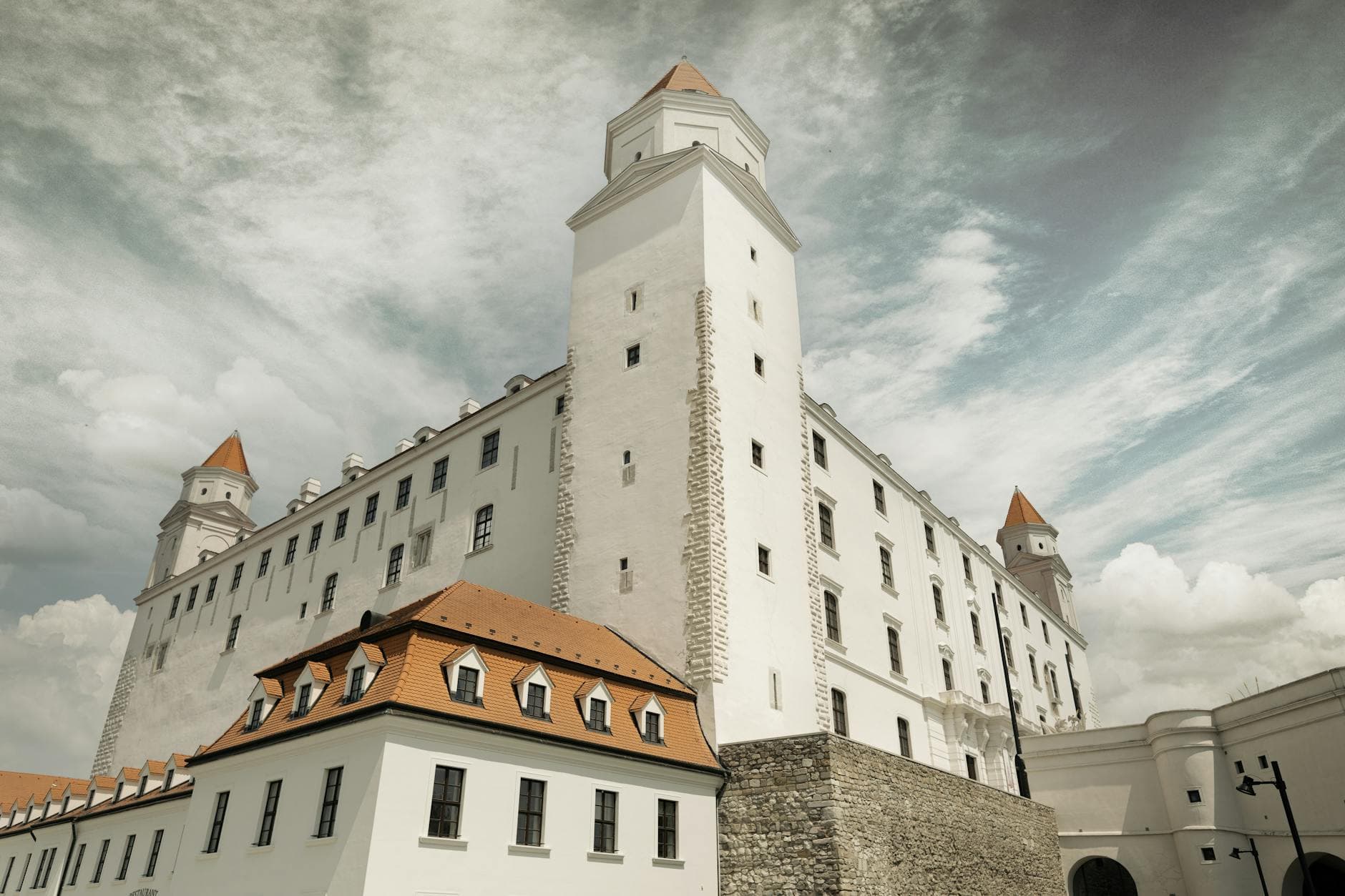
Bratislava Castle, Devín Castle, Spiš Castle (UNESCO, largest in Central Europe), Banská Štiavnica - Slovakia's medieval-to-Baroque icons
Explore
6 reasons people stay longer than they planned
The pull of Slovakia isn't one big thing - it's a stack of small ones, each compounding the others.
EU & Eurozone at emerging-market prices
Slovakia is one of only five Central/Eastern European countries using the euro, eliminating currency risk. Rent a quality 1BR in Bratislava for €650–€850/month - compared to €1,200–€1,800 in Vienna, just one hour away by train. A pub lunch costs €6–€9, a beer €2–€3.50.
Spectacular nature within easy reach
The High Tatras - the smallest alpine mountain range in the world - offer 600+ km of marked hiking trails and 4 ski resorts, all within 3.5 hours of Bratislava. Slovak Paradise National Park, Demänovská Ice Cave, and the Danube cycling path provide year-round outdoor adventures.
Europe's most connected small country
Bratislava is 60 km from Vienna (1 hour by train, €12–€15), 330 km from Prague (4 hours), and 200 km from Budapest (2.5 hours). Vienna International Airport (VIE) is just 50 minutes from central Bratislava, giving access to 170+ destinations. Bratislava Airport (BTS) serves 40+ routes via Ryanair and Wizz Air.
Growing tech scene and IT talent pool
Bratislava hosts offices for IBM, Dell, Lenovo, AT&T, Accenture, and ESET (Slovakia's homegrown cybersecurity unicorn). Košice's IT Valley cluster employs 15,000+ tech workers. Average IT salaries reach €2,800–€3,500/month net, and coworking spaces start from €80/month.
Universal healthcare with low costs
Slovakia's mandatory public health insurance (VšZP, Dôvera, or Union) covers GP visits, specialists, hospital stays, and prescriptions. Employer contributions are 10% of salary. Private clinics in Bratislava charge €40–€80 per consultation. Dental cleanings cost €30–€50 - a fraction of Western European prices.
Rich culture and warm hospitality
Slovakia produces excellent wines in the Small Carpathian Wine Region (just 30 minutes from Bratislava), hosts vibrant Christmas markets, and celebrates folk traditions in Čičmany and Vlkolínec (UNESCO villages). Bratislava's café culture, craft beer scene, and riverfront dining along the Danube make daily life genuinely enjoyable.
2 cities, 2 different lives
Pick the rhythm that fits - capital buzz, beach mornings, or a slow-living escape.

Bratislava
Europe's most underrated capital - 60 km from Vienna at half the price.
€1,200–€1,700 /mo
Young professionals, budget expats, families

Košice
Slovakia's creative second city - European Capital of Culture with IT Valley ambitions.
€900–€1,300 /mo
Budget expats, students, nature lovers
Everything, in plain words
Visa rules, healthcare, schools, taxes - written like a friend would explain it, not like a brochure.
Visa & Residency
Slovakia is a Schengen Zone and EU member, allowing visa-free entry for US, UK, Canadian, Australian, NZ citizens for up to 90 days in any 180-day period. Long-stay options: the **Trade Licence (Živnosť)** for self-employed freelancers, **Employee Card (Single Permit)** for company-sponsored workers, and **EU Blue Card** for highly skilled professionals (~€2,024/mo gross, 1.2× avg wage). **Major 2025/2026 immigration changes**: business residence permit quotas slashed to 700/year nationwide (from 10,256 in 2024), applications now only at home-country consulates. **Digital immigration portal fully live from 18 Feb 2026** - apply online for residence permits, passports and EU Blue Cards; fingerprints submitted in person within 30 days; permit delivered by courier. **Type D residence permit validity extended from 90 to 120 days**. **Entrepreneurial residence visa now issued directly for 3 years** (was up to 3). Colour photos no longer required; financial self-sufficiency proved via bank balance certificate only. New PR language requirement: A2 Slovak (for long-term residence permit). Citizenship 8 years + B1 + civics.
Read 🏥Healthcare
Slovakia's healthcare system is based on universal coverage through mandatory social health insurance. Three competing insurance companies - Všeobecná zdravotná poisťovňa (VšZP, state-owned), Dôvera, and Union - cover all legal residents. Employer contributions are 10% of gross salary (employer share) plus 4% (employee share). The system covers GP visits, specialist referrals, hospitalisation, emergency care, and basic prescriptions. However, public hospitals - especially outside Bratislava - can be underfunded and understaffed. Many expats supplement with private health insurance for access to modern private clinics with English-speaking staff. Bratislava has the best medical facilities in the country, including several private hospitals and dental clinics popular with medical tourists from Austria.
Read 💰Cost of Living
Slovakia adopted the euro in 2009, making it one of the few Central European EU members in the Eurozone. This eliminates currency exchange risk for European expats and simplifies cross-border banking. The flat income tax rate is 19% for earnings up to €47,537 and 25% above that threshold (since 2024). There is no dividend tax for individuals. Social contributions total approximately 34.6% for employers and 13.4% for employees. Cost of living is 40–50% below Vienna and 20–30% below Prague, with Bratislava being the most expensive city and Košice offering significantly lower costs. The average gross monthly salary reached €1,680 in 2025.
Read 🏠Housing
Slovakia's rental market is active but relatively small compared to Western European countries, as home ownership rates exceed 90% - one of the highest in the EU. In Bratislava, most expats rent furnished or semi-furnished apartments through agencies or online portals. Rents have risen steadily since 2020 but remain far below Vienna or Prague levels. Košice offers even more affordable options. Standard lease terms are 12 months with 1–2 months' deposit. The Petržalka tram line opening in July 2025 has boosted interest in previously overlooked Bratislava neighborhoods. Airbnb is widely available for short-term stays while apartment hunting.
Read 💼Work & Business
Slovakia's labour market offers opportunities in IT, shared services, automotive manufacturing, and professional services. Bratislava hosts European headquarters and shared service centres for major multinationals including IBM, Dell, Lenovo, AT&T, Accenture, Johnson Controls, and Amazon. Košice's IT Valley cluster employs over 15,000 tech workers at companies like T-Systems, Siemens, and GlobalLogic. ESET, the cybersecurity company, is Slovakia's most famous tech export. The average gross monthly salary reached €1,680 in 2025, with IT professionals earning €2,500–€4,000 gross. Unemployment was just 5.5% in 2025, with near-full employment in Bratislava.
Read 🌆Daily Life
Daily life in Slovakia combines Central European charm with modern conveniences at affordable prices. Bratislava is compact and walkable, with efficient public transport and a growing café culture along the Danube. Košice offers a more relaxed pace with a beautifully restored Old Town centered on the longest main street in Europe (Hlavná ulica). Slovak cuisine is hearty and satisfying, with bryndzové halušky (potato dumplings with sheep cheese) as the national dish. International cuisine is increasingly available in Bratislava, from Vietnamese phở to Japanese ramen. The country is remarkably safe - Slovakia ranks in the top 30 on the Global Peace Index - and violent crime affecting expats is virtually unheard of.
Read ✈️Moving Guide
Moving to Slovakia is straightforward for EU citizens and manageable for non-EU nationals with a job offer or business plan. The country's compact size, EU membership, and use of the euro simplify logistics. Bratislava's proximity to Vienna means you can even fly into VIE and take a bus or taxi to Slovakia. The key steps involve securing accommodation, registering with the Foreigners Police, obtaining health insurance, and (for non-EU) getting your residence permit. The process is bureaucratic but predictable. English-speaking relocation agencies in Bratislava can handle most paperwork for €500–€1,500.
Read 📚Education
Slovakia offers both public and private education options for expat families. The public school system is free and compulsory from ages 6–16, taught in Slovak. For expat children who don't speak Slovak, several international schools in Bratislava offer British, American, and IB curricula in English. Košice has fewer international options but the University of P.J. Šafárik offers English-taught programmes. Slovakia has a strong tradition of technical education, and its universities (Comenius, STU, TUKE) are increasingly attracting international students with affordable tuition (€2,000–€5,000/year for English programmes).
Read 🌅Lifestyle
Slovakia offers an exceptional work-life balance with stunning natural landscapes, rich cultural traditions, and a growing urban lifestyle scene. The country boasts 9 national parks, 14 UNESCO World Heritage sites, and some of the best hiking, skiing, and thermal spa culture in Central Europe. Bratislava's Danube riverfront has been transformed with the Eurovea complex, while Košice pulses with creative energy from its 2013 European Capital of Culture legacy. Weekends might mean skiing in the High Tatras, wine tasting in the Small Carpathian region, or relaxing at thermal spas in Piešťany. Slovakia's compact size means no destination is more than 5 hours away by car.
Read 📈Investing
Everything expats need to know about investing in Slovakia - from property and stocks to tax-efficient strategies, brokerage access, and building wealth abroad.
ReadTools to plan your move to Slovakia
Practical tools to turn an idea into a real plan - pick a season, time your visa, build a budget, even live a day before you go.
Best time to move to Slovakia
Season-by-season - weather, visa timing, rental markets, and expert tips
Bratislava cost of living
Full monthly budget breakdown - rent, food, transport, utilities
Country match quiz
Eight quick questions, AI-matched country shortlist for your lifestyle
Visa finder
Search visa options by nationality, budget, and stay length
A day in Slovakia
Live a perfect day with AI - real cafés, costs, and routes
Relocation plan
Step-by-step AI moving timeline tailored to your situation
Slovakia vs the rest
See how Slovakia stacks up against other popular expat destinations.
Where Slovakia ranks
See where Slovakia sits in our independent expat rankings - cost, safety, healthcare, and more.
Cheapest Countries for Expats
Ranked list of the most affordable countries for expats in 2026. Monthly budget, cost of living, internet speed, and city guides for each destination.
Countries Under $1,500/Month Cost of Living
Complete list of countries where a single expat can live comfortably on under $1,500 per month. Budget breakdowns, internet speeds, and city guides included.
Countries Where $2,000/Month Is Enough
All countries where a single expat can live well on $2,000 per month or less. Ranked by cost of living with budget details, internet, and English proficiency.
Best Countries for Remote Workers
Top countries for remote workers ranked by internet speed, cost of living, and English proficiency. Find your ideal work-from-anywhere destination in 2026.
Countries With the Fastest Internet
Ranked list of countries with the fastest broadband internet speeds for expats. Average Mbps, cost of living, and city guides for each destination.
Best Countries for Retirement Abroad
Warm-climate countries where one person can live on $2,500/month, ranked safest first by Global Peace Index. Portugal leads, then Malaysia and the Maldives. 2026.
Honest answers
The questions everyone asks before they pack a single box.
How much does it cost to live in Slovakia as an expat?
What visa do I need to move to Slovakia?
What is healthcare like in Slovakia for expats?
What are the best cities to live in Slovakia as an expat?
Is Slovakia a good place to live as an expat in 2026?
Personal Relocation Assessment
Can you actually move to Slovakia?
This page is general. Your case is not. Our relocation expert researches your nationality, income and timeline against the law as it stands, names the instrument behind every figure, and tells you where you actually qualify.
Get my assessmentExpat Insights, weekly
Visa updates, cost-of-living shifts, and real expat stories from Slovakia - straight to your inbox.
Which country is right for you?
Answer 6 quick questions about your budget, lifestyle, and priorities. Our AI ranks 122 countries and builds a personalised relocation plan.